
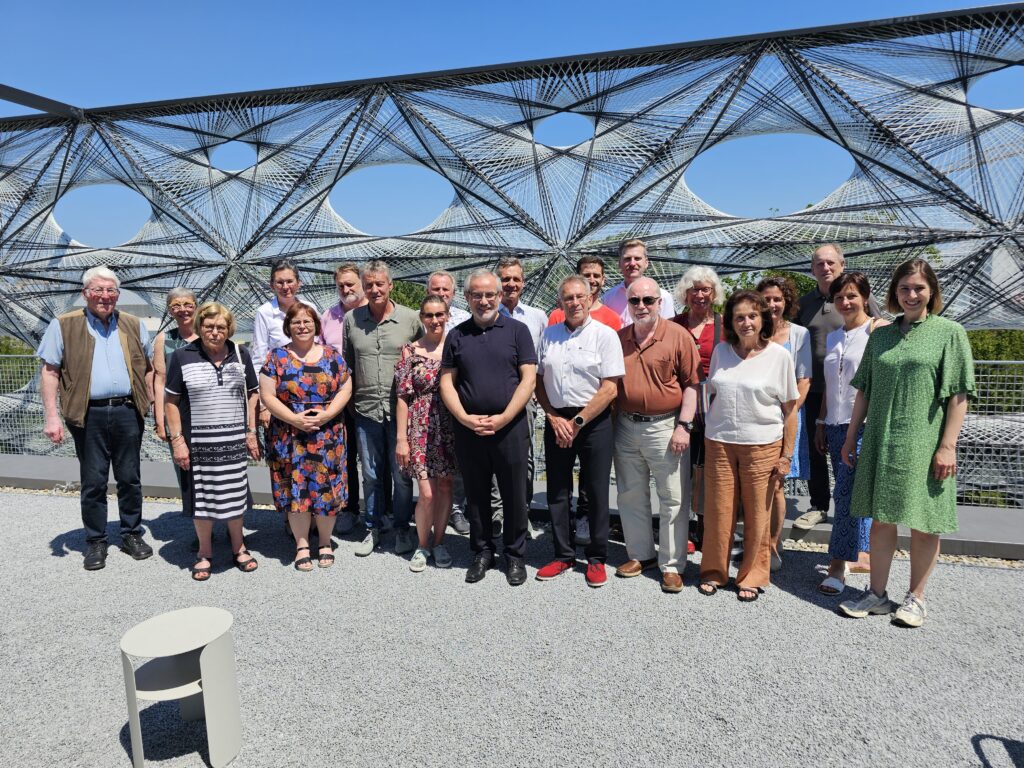
Reutlingen, 21–23 June 2026
On 22 June 2026, this year’s Annual General Meeting of the German regional section of the IFKT (IFWS) took place at the Texoversum in Reutlingen. Following a welcome address by the President, Reinhard Helbig, the former Managing Director, Ms von Bila, opened the meeting with an overview of membership trends over the past year. Treasurer Knobel then presented the financial report for the financial year 2025. Marc Küperkoch, subsequently outlined the IFKT’s activities over the past few months. His report focused in particular on the further development of the website and measures to strengthen external communication.
A key item on the agenda was the scheduled election of the Executive Board for the coming three years. The members present unanimously agreed to a block vote. As a result, Reinhard Helbig was re-elected as President, Mr. Schumacher as Vice-President, Mr. Knobel as Treasurer and Mrs. Baum as Auditor. Marc Küperkoch was newly elected to the Executive Board as General Secretary. With this addition to the Executive Board, the IFWS aims to rejuvenate the association’s work in the long term and attract more young professionals to the IFKT. At the same time, the meeting expressed its sincere thanks to Ms von Bila for her work as interim Managing Director over the past year.
Finally, the members decided on the venue for the 2027 Annual General Meeting. Mönchengladbach was chosen; the event is scheduled to take place in May or, alternatively, September.
Following the official part of the Annual General Meeting, a specialist programme offered insights into current developments in research, teaching and industry. Matthias Rentschler presented the Texoversum as a forward-looking centre for innovation and learning, emphasising the importance of digital technologies and virtual applications for textile education and product development. Jochen Strähle outlined the various textile degree programmes and explained the transformation of university teaching, which is increasingly geared towards the requirements of a digitalised and interdisciplinary textile industry.
Kai Nebel then presented the “Über-Aus” project, which focuses on regional circular economy concepts. The project centres on the evaluation and optimisation of recycling processes, as well as the realisation that recycling is not always the most sustainable solution. Particular emphasis was placed on avoiding overproduction, as this is seen as offering considerable potential for saving resources and energy.
Luigi Schillaci brought the series of talks to a close with a presentation of his company, Knit-Core. The company manufactures seamless products on STOLL flat knitting machines and produces both its own collections and bespoke commissioned work.
After a light lunch together, the participants were given a guided tour of the Texoversum. Among other things, they were shown the Think Tank, which offers students the opportunity to combine digital and analogue development processes and to develop innovative concepts at the interface between the virtual and real worlds. They also visited the spinning, weaving, weft-knitting and warp-knitting departments.
As is traditional, the Annual General Meeting was complemented by a supporting programme featuring a guided tour of the town and a visit to the Knitting Museum. The event concluded the following day with an excursion to Merz b. Schwanen, a company that continues to produce its high-quality circular knitwear on traditional circular knitting machines, thereby successfully combining historic manufacturing techniques with modern product development.